
Meet the synthetic workforce: Highlights from TiECon 2025
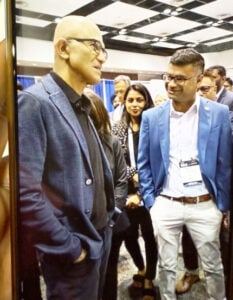
Microsoft CEO Satya Nadella with Avathon’s Sandeep Gupta
At TiECon Silicon Valley 2025, Microsoft CEO Satya Nadella reminded us that AI is not an isolated breakthrough — it’s the result of decades of innovation across personal computing, the Internet, mobile and cloud. Each wave of progress has compounded, giving rise to the explosive momentum we see in AI today.
But perhaps his most lasting point wasn’t technical.
“You can’t innovate without empathy,” Satya said during the grand keynote.
True innovation means understanding the world through someone else’s eyes — knowing what they need and building accordingly.
That message set the tone for my fireside chat later in the day with Claudia Chandra, Chief Product Officer at Honeywell Connected Enterprise. We explored how AI is changing the nature of work in manufacturing and supply chains — and what it means to build with empathy for operators, engineers and frontline teams.
The age of AI-guided work has arrived
Industrial AI is no longer experimental. It’s already reshaping daily operations in sectors like energy, logistics and advanced manufacturing. Claudia and I discussed how AI agents are being deployed across the value chain: optimizing supply chains, improving uptime, reducing safety risks and automating decisions at machine speed.
This isn’t hype. It’s happening. Gartner predicts that by 2027, 40% of operational work in industrial enterprises will be performed by AI agents — up from just 5% in 2023.
Why is AI booming now?
There are several drivers behind this rapid adoption:
- Labor shortages in critical roles, especially as experienced workers retire
- Operational complexity in remote or hazardous environments
- Competitive pressure to be faster, more resilient and more cost-efficient
- Decarbonization goals that require real-time energy optimization
What’s a synthetic workforce, really?
At Avathon, we define the synthetic workforce as a set of AI agents that handle tasks previously done by humans. This includes everything from dynamic planning and predictive maintenance to anomaly detection and report generation.
But this isn’t a story about job losses — it’s about job evolution. AI takes on the repetitive, the hazardous, the slow. Humans move into roles that require oversight, creativity and judgment. Jobs won’t go, but job descriptions will change.
Industrial AI barriers to entry
Of course, deploying industrial AI isn’t plug-and-play. We discussed three big barriers:
- Data readiness: Many operations still lack sensor coverage or unified data systems.
- Contextualization: Raw data isn’t enough. AI needs to be grounded in domain knowledge and first principles to be useful.
- Deployment architecture: In industries like mining or energy, latency and security require hybrid edge-cloud models — not cloud-only tools.
It’s not just about building AI. It’s about engineering it for the realities of industrial environments.
Where are the synthetic workforce’s biggest opportunities?
Here are just a few areas where Claudia and I see momentum:
- Autonomous operations in dangerous environments like offshore rigs or remote mines
- AI-driven training using natural language and extended reality to skill up workers faster
- AI-powered procurement for real-time supplier selection and negotiation insight
- Knowledge preservation using AI to mine decades of unstructured operational history
One Avathon client is is using an agent developed by us that embeds years of data and knowledge from expert technicians. This allows the new technicians to benefit from this knowledge and be much more efficient as they do their jobs.
What AI means for today’s workforce
The future is not jobless — it’s job-shifted. Roles will evolve toward strategic thinking, oversight and AI fluency. As new titles like “prompt engineer” or “operations analyst” emerge, training must keep pace. Upskilling isn’t just a benefit — it’s a necessity.
AI is no longer a pilot program. It’s a production system.
Organizations that embrace the synthetic workforce thoughtfully — with domain context, fast deployment and human partnership — will be the ones that win the next decade.
Sandeep Gupta is Avathon’s SVP of Product.