
AI "Buy vs. Build": Practical AI Adoption, Strategic Positioning, and the N.O.W. Blueprint
by Bart A. De Muynck
The global supply chain landscape is navigating structural shifts marked by persistent trade friction, price volatility, and unyielding market shifts. Linear, deterministic supply chain software built for static environments is no longer viable.
To build resilience, shippers, technology vendors, and investors must pivot from reactive operations to dynamic orchestration. Leveraging the N.O.W. Philosophy and N.E.W. Technology Methodology, this article outlines how to navigate the AI era, balance buy versus build decisions, achieve “AI speed,” and turn supply chain complexity into a decisive competitive advantage.
1. The Strategic Context: The Cost of “Not NOW”
Waiting for clean data, predictable budgets, or a return to market stability—the “Not NOW” trap—erodes enterprise value. In modern supply chains, the gap between market leaders and delayed adopters manifests as an inescapable inaction penalty:
- Margin Compression: Legacy systems rely on deterministic rules and fixed lead times that break during volatile shifts. Laggards risk absorbing substantial input cost increases, whereas agile peers adapt in real time.
- The Data Debt Trap: McKinsey research reveals that enterprise AI initiatives frequently stall because only 4% of enterprise data is AI-ready. Delaying modernization compounds data fragmentation and traps teams in low-value, transactional spreadsheet management (“Scribes”) rather than strategic stewardship (“Stewards”).
- Operational Friction: High-transaction manual workflows lead to alert fatigue, high employee turnover, and unmitigated risk across secondary supply networks.
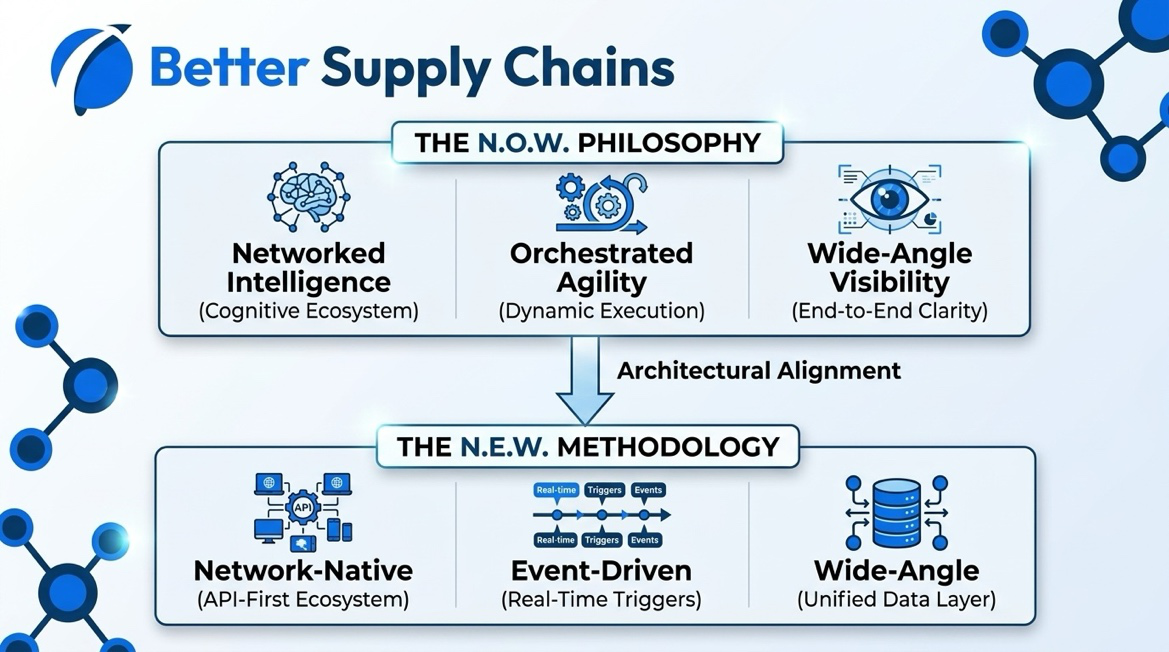
The solution requires adopting the N.O.W. Philosophy:
- N – Networked Intelligence: Transitioning operations from static, siloed decisions to connected, predictive cognitive ecosystems.
- O – Orchestrated Agility: Building modular execution systems capable of rerouting assets and shifting parameters in hours rather than months.
- W – Wide-Angle Visibility: Eradicating blind spots from Tier-N suppliers through final-mile logistics.
Complementing this, technology providers and internal developers must apply the N.E.W. Methodology—ensuring software architecture is Network-Native, Event-Driven, and Wide-Angle to support active operational execution.
2. Navigating the AI Era: Buy vs. Build Decisions
The transition toward AI-driven architectures reopens the classical software trade-off: Build vs. Buy. In an environment where software assets can quickly become technical debt, evaluating this choice requires clear alignment with core business capabilities.
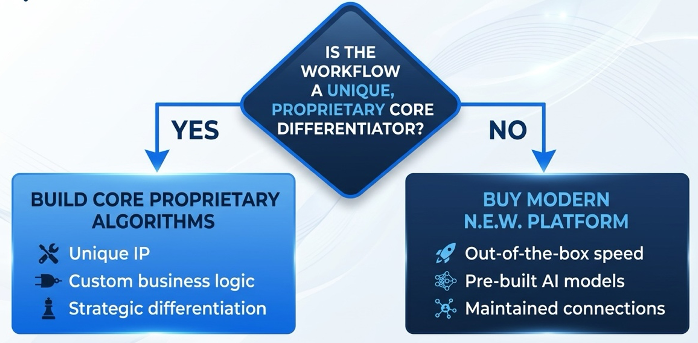
Building Strategy
- Pros: Tailored functionality built specifically for unique domain logic or highly proprietary core workflows.
- Cons: High total cost of ownership (TCO), prolonged engineering timelines, persistent maintenance burden, and the risk of building fragmented point solutions that cannot easily adapt.
- Business Implication: Building makes sense only for capabilities that serve as direct, proprietary market differentiators.
Buying Strategy (Modern N.E.W. Platforms)
- Pros: Rapid time-to-value, continuous vendor-driven AI enhancements, native API integrations, and immediate resolution of underlying data readiness gaps.
- Cons: Requires process alignment to standardized workflows; risk of vendor lock-in if platforms lack API modularity.
- Business Implication: Buying off-the-shelf, event-driven engines allows internal IT resources to focus strictly on unique business value rather than infrastructure upkeep.
3. High-Impact Use Cases & Prioritization
To maximize capital return, AI adoption must focus on proven operational levers. McKinsey research demonstrates that applying AI to targeted supply chain operations yields measurable business impact:
- Logistics & Freight Optimization: 15–20% reduction in logistics costs through dynamic route orchestration and automated load matching.
- Inventory & Demand Sensing: 20–30% reduction in inventory carrying costs and up to a 65% decrease in stockout rates by replacing static time-series forecasts with real-time, probabilistic modeling.
- Procurement & Sourcing Agility: 5–15% savings in procurement spend alongside faster exception resolution across multi-tier supplier networks.
Prioritization should focus on high-friction points where automated exception handling yields immediate financial and operational relief.
4. Achieving “AI Speed”: Fast Wins via Strategic Partnerships
Deploying AI does not require multi-year enterprise transformation programs that risk obsolescence before completion. Fast time-to-value relies on targeted execution and partnering with specialized AI vendors who bring pre-trained models and modular integration architectures.
The Incremental Training Analogy
Starting an AI journey is much like strength training at a gym:
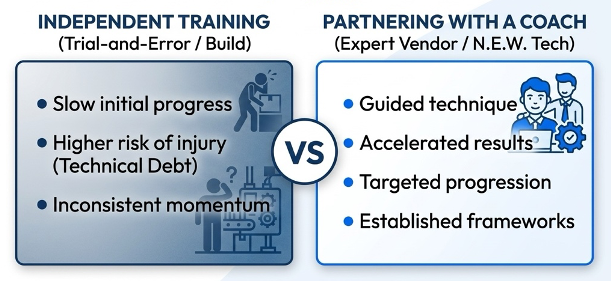
While an organization can attempt self-guided experimentation, progress is often slow, constrained by data formatting issues, and prone to costly trial-and-error. Partnering with an experienced vendor provides pre-established data pipelines, governance guardrails, and proven models. This guided approach enables teams to achieve targeted ROI in 90-day cycles while steadily building organizational muscle.
5. Overcoming Adoption Barriers: Scope Management & Human Capability
The primary challenge in supply chain AI adoption is rarely the technology itself; it is managing scope and organizational readiness.
The 5% High-Impact Strategy
Rather than attempting to digitize every process at once, identify the 5% of high-friction workflows—such as dock-scheduling bottlenecks or Tier-2 material shortage alerts—that generate disproportionate financial leakage. Scope management ensures fast execution and clear proof-of-concept validation.
Building Organizational Capability
AI should augment human decision-making rather than attempt unmonitored replacement:
- Scribes to Stewards: Automate high-transaction, repetitive tasks to free human teams for strategic decision-making and cross-functional exception handling.
- Governed Autonomy: Establish clear human-in-the-loop thresholds. For example, allow AI agents to autonomously re-route shipments under a specific cost threshold, while flagging higher-variance decisions for manager review.
Strategic Action Checklist
To transition from strategy to execution, supply chain leaders should take three immediate steps:
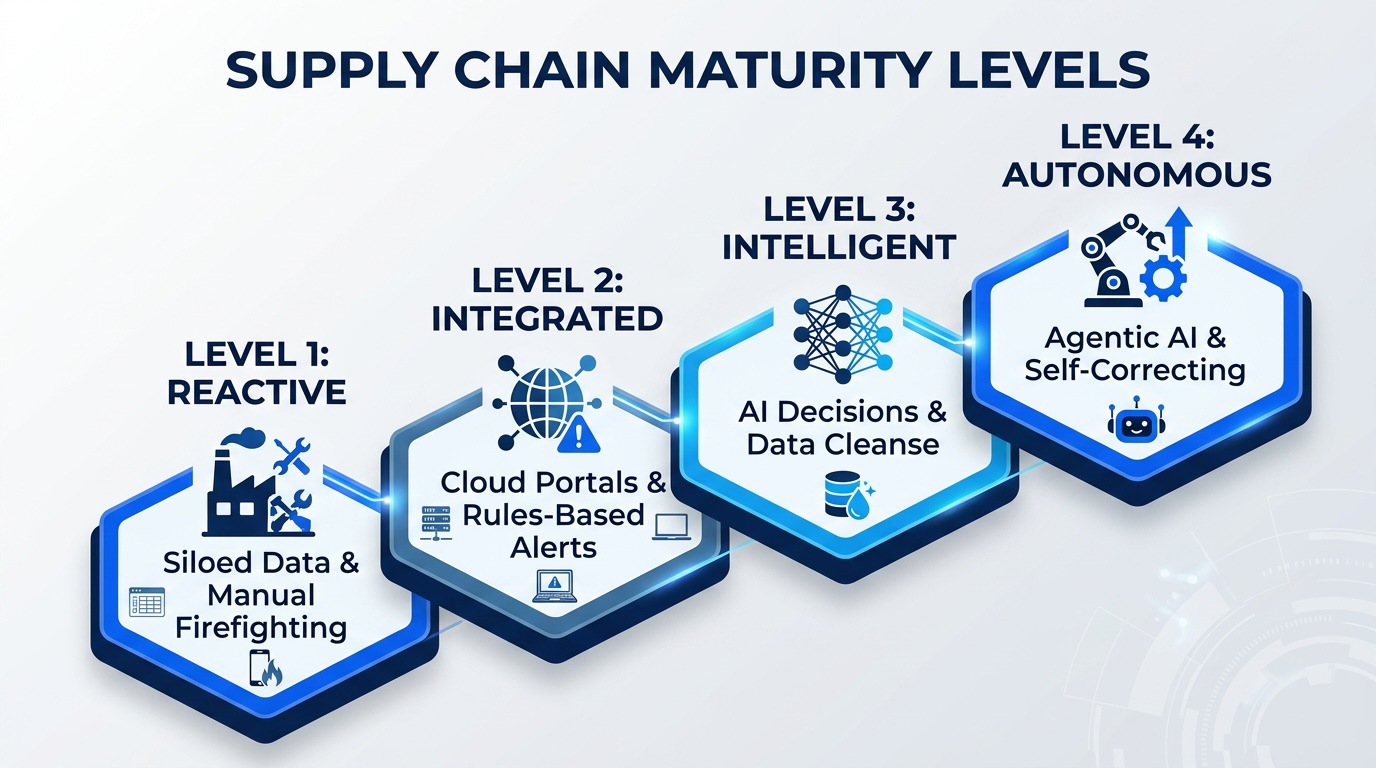
- Conduct a Maturity Assessment: Map current workflows across the 4 maturity levels to pinpoint primary data bottlenecks and visibility gaps.
- Define Core vs. Non-Core Capabilities: Apply the buy-vs-build framework to keep internal development tightly focused on proprietary value.
- Launch a 90-Day Phase 1: Partner with a specialized AI vendor to address a high-leakage operational workflow, establish measurable KPIs, and demonstrate tangible value. Phase 1 is the start of a continued AI project.
By aligning modern software decisions with the N.O.W. Philosophy and N.E.W. Technology Methodology, organizations transform supply chain operations into an elastic, proactive growth engine.
What specific operational bottleneck in your network is currently consuming the most manual effort and limiting your agility?
To learn more about how Avathon's Autonomy Platform optimizes logistics and supply chain performance, visit our site.