
Automotive Manufacturing and AI: Driving Performance Optimization
AI has moved from an experimental efficiency tool to the central nervous system of the automotive production line. Here is how it connects demand planning, supply chain, factory-floor execution, compliance, and after-sales service.
Introduction
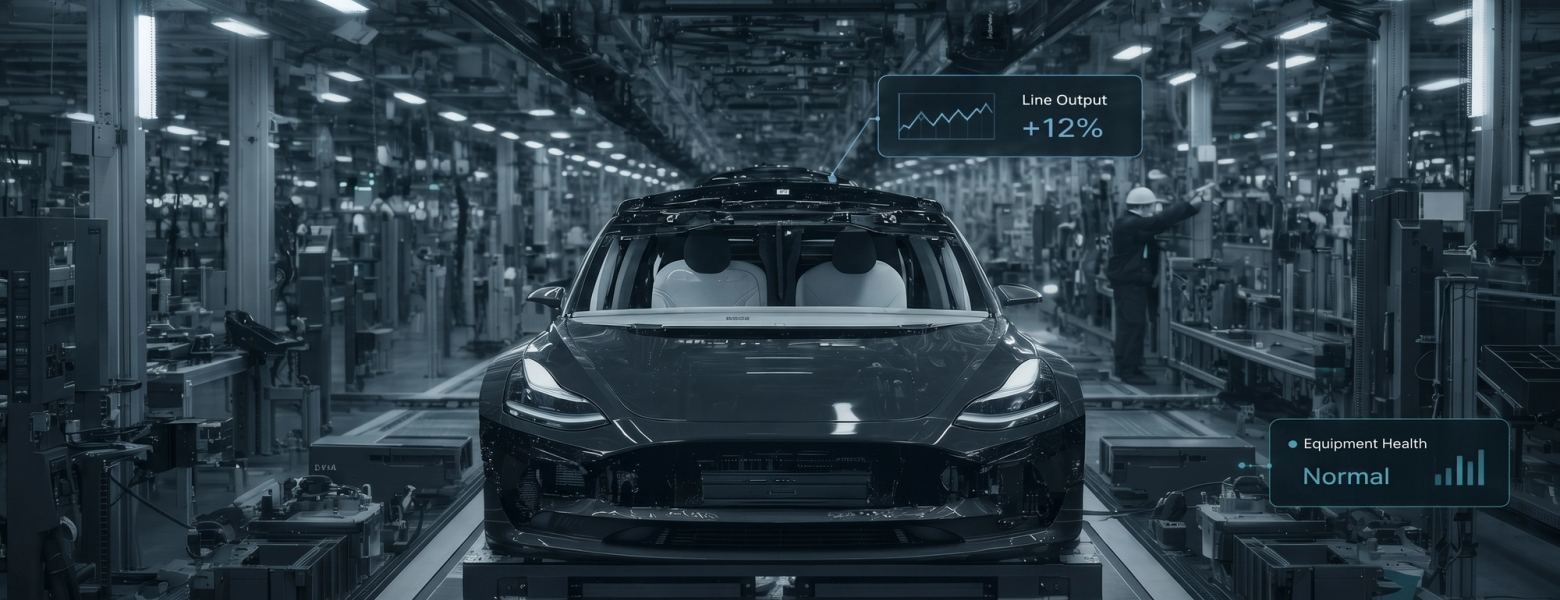
The factory floor is no longer defined merely by sparks, steel, and mechanical precision. It is increasingly powered by algorithms. In automotive manufacturing, artificial intelligence (AI) has evolved from an experimental efficiency tool into the central nervous system of modern production lines. From predicting equipment failures before a single bolt comes loose to customizing vehicles at full assembly speed, AI is fundamentally retooling how vehicles get produced.
Automation made its initial appearance in the automotive industry back in the 1960s with the implementation of the first manufacturing robots (Unimate in 1961 laying claim to the very first system used in actual production). At that point, the main opportunity for intelligent manufacturing was safety improvement, giving robots the tasks that were easily repeatable and hazardous for human workers, things like spot welding and moving heavy parts and assemblies.
AI has, since then, played a transformative role in automotive manufacturing by optimizing production processes, enhancing quality, increasing efficiency and worker safety, and accelerating product development. AI now leverages machine learning, computer vision, and real-time data analysis to create smarter, faster, and more reliable factories.
Use cases where AI is changing the face of auto manufacturing
Sales, demand, and production planning
- Sales reporting and trend analysis: Aggregates real-time sales data from dealerships, digital commerce platforms, and fleet operations into centralized dashboards. Machine learning models analyze historical sales cycles, macro-economic factors, regional buyer preferences, and consumer sentiment to identify emerging market trends.
- New product development, cannibalization analysis, and end-of-life management: Simulates market demand for new vehicle concepts and features (for example, EV range variations or trim levels) to accelerate product development lifecycles. Predictive models evaluate whether launching a new model or powertrain variant will siphon demand away from an existing model line or capture net-new market share. AI forecasts when demand for retiring vehicle models will drop, allowing automakers to phase out production gracefully, optimize warranty part reserves, and transition assembly lines smoothly to next-generation vehicles.
- External market forces driving demand: Ingests non-traditional datasets, including fuel prices, raw material costs, interest rate changes, government EV subsidies, trade tariffs, and weather anomalies, to assess external macroeconomic drivers.
- Product mix forecasting: Processes historical buyer choices (trim, colors, engine, and feature combinations), dealer inventory turns, and regional climate data to predict the optimal mix of vehicle configurations per market.
- Parts and assembly requirements forecasting: Translates high-level vehicle production forecasts down to individual component and tier-1 or tier-2 supplier level requirements.
- Production planning and inventory management: Schedules assembly line sequences to minimize changeover times, account for factory constraints, and optimize energy and material usage.
Material planning, supply chain, and logistics
- Multimodal route optimization: Evaluates real-time traffic conditions, weather disruptions, port congestion, and fuel prices across trucking, rail networks, and ocean freight to calculate the most cost-effective and timely transit routes. Predictive algorithms analyze sensor data on cargo vessels, railcars, and trucks to continuously update estimated arrival times, automatically alerting plants to potential delays in critical component deliveries. Computer vision and 3D packing algorithms optimize cargo load arrangements in trucks and shipping containers to maximize volume efficiency and reduce total transport costs.
- Strategic sourcing and procurement: Monitors global news, financial stability scores, labor strikes, and climate risks to identify vulnerable supply nodes before a disruption hits the assembly line.
- Supply chain optimization: Analyzes massive datasets, including historical sales, demand forecasts, supplier delivery rates, lead-time variance, price adherence, communication efficiency, weather, and market trends, allowing manufacturers to achieve just-in-time production by accurately forecasting demand, optimizing inventory levels, and streamlining logistics routes, which reduces stockouts and excess inventory.
- Carrier screening, selection, and tendering: Matches shipments with optimal carriers based on delivery history and target rates, automatically executing freight tendering without manual logistics intervention.
- Procurement, sourcing, payment, and contract management: Natural language processing inspects procurement contracts to flag non-standard clauses, liability risks, and compliance gaps across thousands of vendor agreements. Computer vision combined with machine learning automatically reconciles purchase orders, bills of lading, and vendor invoices to detect billing errors, eliminate duplicate payments, and trigger timely automated payouts.
- Part provenance: Maps component journeys from raw material extraction to final assembly, ensuring ethical sourcing compliance such as conflict-free minerals and sustainable battery materials.
- Part quality and standard adherence: Computer vision systems equipped with thermal and HD cameras scan incoming parts, raw materials, and sub-assemblies upon arrival to instantly detect surface defects, micro-cracks, or incorrect dimensions.
Operations
- Staff scheduling: Evaluates worker skills, certification requirements, shift history, and line speeds to automatically generate optimal shift schedules and reallocate personnel in real time to prevent bottlenecks.
- Operational efficiency and energy usage: Monitors production line data to identify inefficiency and waste, dynamically adjusting machine operations and energy consumption based on production load, helping manufacturers reduce carbon footprint and operating cost.
- Assembly equipment performance and predictive maintenance: Analyzes sensor data (vibration, temperature, power consumption) from machinery on the assembly line to predict equipment failure before it occurs. This proactive approach prevents costly, unplanned downtime and optimizes maintenance scheduling.
- Equipment health and longevity optimization: Tracks historical wear-and-tear patterns across high-value machinery, recommending optimal operating thresholds to maximize asset lifespan.
- NBM-based anomaly detection and mitigation: Compares real-time operational signatures against normal behavior modeling (NBM) baselines to detect micro-deviations such as voltage spikes, micro-vibrations, or pressure drops that traditional threshold alarms miss.
Manufacturing
- Accelerated design and development: Simulates and tests thousands of design iterations for components or entire vehicles, drastically cutting time-to-market and R&D costs while optimizing attributes like performance, safety, and material efficiency before physical prototyping begins.
- Autonomous assembly and robotics: Enhances traditional robotics by allowing them to be more adaptable and precise. Collaborative robots work safely alongside human operators, taking on repetitive or hazardous tasks with real-time adjustments based on sensor input, increasing overall efficiency and safety.
- Quality control and defect detection: AI-powered computer vision systems inspect parts and assemblies in real time with unparalleled accuracy. They can spot minute defects, such as surface scratches, paint inconsistencies, or misalignments, that are often invisible or difficult for human inspectors to detect consistently. This reduces errors, waste, and the risk of faulty products reaching the customer.
Regulatory, compliance, and safety
- Global trade and tariff management: Analyzes technical specifications, mechanical CAD data, and material compositions to automatically map complex automotive parts and complete vehicles to correct tariff codes, minimizing misclassification risks and customs delays.
- Managing BOMs, FTAs, and drawbacks: Parses multi-tier costed bills of materials (BOMs) to verify regional value content and tariff shift requirements across agreements like USMCA or EU trade treaties, automatically determining duty-free eligibility. AI reconciles complex export records with historical import duties paid, automatically identifying eligible duty drawbacks and generating audit-ready recovery claims for overpaid tariffs.
- Worker safety and environmental compliance: Enhances worker safety by visually monitoring for correct personal protective equipment usage, hazardous worker and machine interactions, perimeter security breaches, and other risky events or conditions, including unsafe worker movements, repetitive stress hazards, or heavy-lifting postures, to prompt workspace redesigns before injuries occur.
- Visual systems for risk identification: Continuous camera surveillance audits assembly zones, welding lines, and high-voltage EV battery assembly cells for fire hazards, smoke, or ungrounded electrical setups.
- Environmental and plant maintenance: Tracks stack emissions, VOC levels from paint shops, and wastewater outflow, identifying compliance breaches before limits are exceeded to enhance safety and avoid regulatory penalties.
Customer sales and support
- Shipment tracking with dynamic ETAs: Integrates real-time status data from car haulers, railcars, and cargo vessels with live weather, port dwell times, and border crossing congestion data to recalculate precise arrival times down to the hour. Machine learning provides OEMs, fleet managers, and end customers with proactive updates on vehicle movement from the factory gate to the final dealership lot, automatically re-routing shipments when delays occur.
- Load planning and optimization: Optimizes container fill rates and truck deck space for inbound components, grouping parts from multiple tier-1 and tier-2 suppliers into single multi-stop routes to reduce overall transit volume. 3D spatial optimization algorithms arrange finished vehicles onto multi-level auto transporters and specialized railcars, maximizing capacity based on vehicle dimensions, weight limits, and drop-off sequences.
- Pick-up and delivery scheduling: Schedules driver routes and time slots for car-carrier pick-ups at port and rail terminals and for home and dealership deliveries, accounting for driver hours-of-service regulations and local traffic patterns. AI orchestrates dynamic scheduling at vehicle distribution centers and dealership receiving yards, assigning specific dock doors and drop zones to incoming haulers to prevent yard gridlock.
- Post-sales spare parts and maintenance management: Models global vehicle population data, failure probabilities, seasonal driving patterns, and recall risks to forecast localized regional needs for service parts, preventing stockouts at service centers. AI copilots guide dealership service technicians through complex vehicle repair diagnostics by analyzing error codes, technical service bulletins, and historical repair logs to shorten turnaround times.
- Dealer network management: Analyzes local buyer demographics, real-time sales velocity, and regional vehicle preferences to allocate factory output and automatically suggest dealer-to-dealer inventory swaps.
The challenges of implementation and scaling
Despite numerous successful pilots, the industry faces many operational hurdles in achieving widespread AI implementation.
- Data challenges: The automotive value chain generates massive, fragmented, and often incompatible data from sensors, ERP systems, maintenance logs, and more. Data silos, quality issues, and a lack of interoperability are major obstacles impeding a holistic AI approach.
- Fragmentation versus scale: While nearly 9 in 10 organizations are using AI in at least one business function, most are still in the piloting or experimentation phase and have not yet scaled the technology throughout their organizations.
- High upfront costs: The initial investment required for high-end AI hardware, software infrastructure, and expert talent remains a significant barrier, particularly for smaller suppliers.
- The skills gap: The traditional manufacturing workforce needs substantial upskilling, estimated at over 50% of workers by 2025, to manage, maintain, and interact with AI systems like large language models and machine learning systems.
- Legacy systems: Older manufacturing companies still often rely on outdated legacy systems that are incompatible with modern AI technologies, making integration operationally challenging and costly.
Conclusion: AI has the power to transform automotive manufacturing
By bridging market intelligence, supply chain management, factory-floor execution, regulatory compliance, and post-sales delivery, AI has evolved from a series of point-solution automation tools into the connective tissue of modern automotive manufacturing. It transforms fragmented, complex global ecosystems, from predicting component demand and optimizing robotic assembly lines to ensuring worker safety, streamlining international trade, and driving proactive customer service, into an interconnected, self-optimizing network. Ultimately, automakers that harness this end-to-end operational intelligence achieve not only superior agility and cost efficiency, but also the resilience required to thrive amid continuous economic, technological, and market disruptions. AI has established itself as an invaluable tool in high-value automotive manufacturing.
To learn more about Avathon's Autonomy for Manufacturing platform, visit our site.