By Bart A. De Muynck
Introduction
Navigating the Great Reconfiguration in 2026 requires an urgent shift in how organizations approach digital transformation. The implementation and integration of Artificial Intelligence (AI) has become a core focus for most supply chains in 2026.
But companies can no longer afford to view artificial intelligence as a standalone technology project. Instead they must treat it as an evolutionary milestone for their processes and people.
Much like the foundational Six Sigma methodologies of past decades, which fundamentally proved that automating a broken, inefficient process only accelerates chaos, successful AI implementation demands that business processes and their supporting software be reengineered and stripped of friction before any software is deployed.
True value realization does not come from a generic, monolithic “rip and replace” technology cycle. It thrives at the Human-Machine Frontier, where repetitive, high-transaction tasks are systematically automated specifically to elevate employees from manual “Scribes” into strategic network “Stewards”.
By anchoring an AI roadmap supported by process normalization and controlled human governance, forward-thinking shippers and investors can transform a chaotic cost center into an agile, proactive competitive advantage.
A Successful AI Roadmap
—Bart A. De Muynck (Chairman, Spitzberg Partners, LLC )
To be successful at introducing AI in Supply Chains, leaders need to create a clear roadmap to deploy it. Having a clear roadmap and an organized implementation approach is the fundamental key to creating tangible value from AI.
Supply Chain leaders should partner their operations and IT teams with their technology vendors to come up with valuable use cases based on their AI strategy and roadmap. Projects often fail at launch when operations users aren’t engaged early enough. Instead of feeling ownership, they feel handed a new process they didn’t help shape—and with which they disagree.
Here are several key steps companies need to make to turn AI implementation into a success rather than failing and risking large setbacks that can cost them a key competitive advantage.
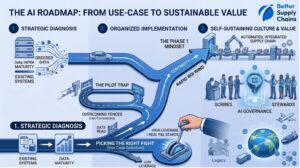
1.Picking the Right Fight: High-Leverage Decision Making
The journey begins with selecting the right use case, which is arguably the highest-leverage decision an executive will make. Leaders must move beyond “science experiments” and focus on initiatives with real P&L stakes—projects significant enough that the first roadblock does not become an exit ramp.
Success requires identifying the “skills gap” where AI acts as a relief rather than a threat. When AI is positioned as the answer to an impossible workload, fear disappears. Furthermore, leaders must conduct an honest data analysis; while data is often dismissed as “not good enough,” having the right focus on data quality allows quick early wins. While AI needs good data, AI itself can help improve data quality.
2. Implementation: The “Phase 1” Mindset
A successful implementation strategy avoids the “Pilot Trap”. A pilot implies an experiment with a built-in exit; conversely, a “Phase 1” mindset builds in continuity from day one. This organized approach ensures that AI is treated as a learning system that discovers new data to deliver incremental value over time. It is a learning process for decision making that will evolve over time.
To maintain momentum, the implementation must prioritize rapid progress toward high ROI. Frequent, visible wins keep stakeholders engaged and move skeptics to the sidelines. Crucially, leaders must get the right people—both approvers and operators—in the room early to ensure surprises do not become blockers. This helps ensure they believe they are partners in the future, not recipients of a flawed design for operational execution. There’s also joint accountability if this is designed together. Team wins and team shortcomings ensure longer term collaboration.
3. From Use Case to Self-Sustaining Culture
Scaling AI requires navigating institutional friction. Leaders must recognize that many perceived barriers—IT blockers, data migrations, or procurement hurdles—are often “fences” rather than “fortresses”. By approaching these obstacles with a clear ROI-driven mandate, teams can push through the “Real World” challenges of Phase 2.
Once an organization secures its first major win, the culture begins to shift. The internal dialogue moves from questioning “Will this work?” to exploring “What else can we do?” This is the tipping point where AI adoption becomes self-sustaining, transitioning the workforce from “Scribes” performing manual data entry to “Stewards” who govern a cognitive ecosystem.
Conclusion: The 2026 Mandate
The cost of inaction—the “Not NOW” trap—is a fundamental erosion of enterprise value, leading to insolvency risks and systemic failures. By following a structured roadmap—diagnosing maturity, architecting modular systems, and activating AI-assisted workflows—leaders can transform a reactive cost center into a proactive competitive advantage. The time to act is NOW, because the storm of reconfiguration is already here.
To learn more about how Avathon can empower your AI development roadmap, visit our site.